The 10 Mahavidyas in Tantra: Meanings, Powers & Esoteric Significance
The Complete List of the 10 Mahavidyas & Their Esoteric Meanings
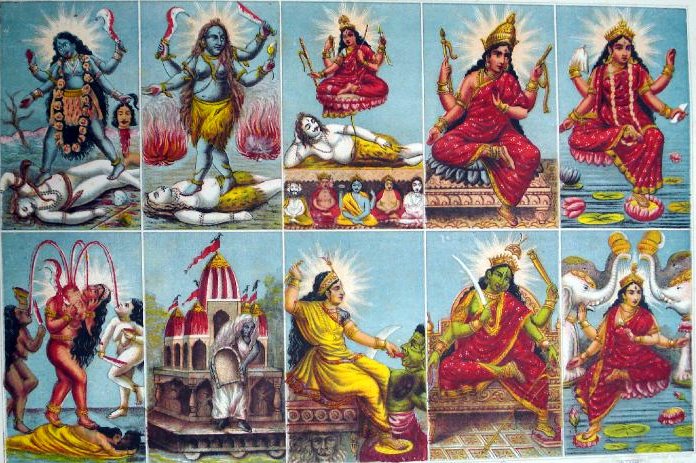 The Ten Mahavidyas: The Wisdom Goddesses of Tantra and the Sacred Journey of Transformation
“The Divine Mother wears many faces. She is gentle as dawn, fierce as lightning, silent as the night sky, and radiant as infinite wisdom. Together, these forms are known as the Mahavidyas—the Ten Great Wisdom Goddesses of the Tantric tradition.”
At midnight in an ancient temple, a single oil lamp flickers before a stone image of the Divine Mother. The air carries the fragrance of sandalwood and incense. Somewhere in the distance, a temple bell echoes through the darkness.
For centuries, seekers have approached these sacred spaces not merely to ask for blessings, but to understand a deeper mystery: Why does the Divine appear in so many different forms?
The answer, according to many Tantric traditions, is found in the Mahavidyas—ten manifestations of the Divine Mother, each revealing a distinct aspect of reality and inner transformation.
The Mahavidyas are not simply ten goddesses to be worshipped independently. They are often understood as ten windows into the same infinite consciousness. Together they express creation and dissolution, compassion and courage, beauty and austerity, speech and silence, abundance and renunciation.
What Does “Mahavidya” Mean?
The Sanskrit word Mahavidya combines two terms:
- Maha – Great
- Vidya – Knowledge or Wisdom
Thus, Mahavidya means “Great Wisdom.”
In Shakta and Tantric traditions, the Mahavidyas represent profound spiritual principles rather than merely external forms. Their iconography, myths, and mantras invite contemplation on different dimensions of existence.
The Origin Story
One of the best-known traditional narratives appears in later Puranic and Tantric literature.
When Shiva chose not to attend the great sacrifice organized by Daksha, Sati wished to go despite his objections.
According to the story, when Shiva attempted to leave, Sati manifested ten awe-inspiring forms that surrounded him in every direction.
These ten manifestations became known as the Mahavidyas.
Whether understood literally, symbolically, or devotionally, the story illustrates an important idea: the Divine cannot be confined to a single expression.
1. Kali – Beyond Time
Kali is perhaps the most widely recognized Mahavidya.
Her dark complexion symbolizes the limitless, formless reality from which all creation emerges and into which it returns.
Her garland of skulls and association with cremation grounds are not celebrations of death but reminders of impermanence and the ego’s eventual dissolution.
In many traditions, Kali represents fearless transformation and the courage to confront what we normally avoid.
2. Tara – The Compassionate Guide
The name Tara means “She Who Ferries Across.”
She is revered as a guide through danger, uncertainty, and spiritual ignorance.
While Kali embodies radical transformation, Tara is often portrayed as compassionate protection and wise guidance.
Her symbolism emphasizes the possibility of finding clarity amid life’s storms.
3. Tripura Sundari (Shodashi)
Tripura Sundari, also known as Shodashi or Lalita, embodies beauty, harmony, and the blissful aspect of the Divine.
She is closely associated with the Shri Yantra, one of India’s most celebrated sacred geometric diagrams.
Rather than worldly beauty alone, her form symbolizes the harmony of consciousness, nature, and the cosmos.
4. Bhuvaneshwari – The Queen of Space
Bhuvaneshwari is often described as the sovereign of the universe.
Her iconography emphasizes vastness and spacious awareness.
Just as the sky accommodates clouds without being altered by them, she symbolizes the capacity of consciousness to witness experience without becoming limited by it.
5. Bhairavi – The Power of Discipline
Bhairavi represents intensity, determination, and spiritual resolve.
Her fierce appearance reminds practitioners that genuine transformation requires perseverance.
She symbolizes the fire of disciplined practice that burns away complacency and ignorance.
6. Chinnamasta – The Mystery of Self-Sacrifice
Perhaps the most visually striking Mahavidya, Chinnamasta is depicted holding her own severed head while streams of blood nourish herself and her attendants.
This imagery is deeply symbolic.
Rather than encouraging violence, it is commonly interpreted as illustrating the transcendence of ego, the cyclical nature of life, and the paradox that true giving can become a source of renewal.
7. Dhumavati – Wisdom Through Emptiness
Dhumavati appears as an elderly widow, unlike the youthful forms often seen in Hindu iconography.
She represents solitude, impermanence, disappointment, and the wisdom that can arise from loss.
Her teachings invite reflection on life’s quieter, often overlooked dimensions.
8. Bagalamukhi – The Power of Stillness
Bagalamukhi is traditionally depicted restraining the tongue of an adversary.
Symbolically, this image has been interpreted as mastering harmful speech, calming conflict, and developing inner steadiness.
Rather than focusing solely on external opponents, many practitioners understand her imagery as pointing toward restraint of one’s own destructive impulses.
9. Matangi – The Goddess of Inspired Expression
Matangi is associated with speech, music, learning, and creativity.
She is often regarded as a patron of artists, musicians, poets, and seekers who wish to cultivate refined expression.
Her symbolism reminds us that words have the power to heal, inspire, and transform.
10. Kamala – The Lotus of Abundance
Kamala shares many visual similarities with Lakshmi.
She represents prosperity, nourishment, generosity, and spiritual abundance.
The lotus on which she sits symbolizes purity emerging from the muddy waters of worldly existence.
Her teachings suggest that material well-being and spiritual values need not be in conflict when approached with wisdom and gratitude.
The Mahavidyas as an Inner Journey
Many teachers interpret the ten Mahavidyas not merely as external deities but as archetypal stages of inner transformation.
Kali teaches courage.
Tara teaches guidance.
Tripura Sundari teaches harmony.
Bhuvaneshwari teaches spacious awareness.
Bhairavi teaches disciplined effort.
Chinnamasta teaches surrender of ego.
Dhumavati teaches acceptance of impermanence.
Bagalamukhi teaches restraint and stillness.
Matangi teaches mindful expression.
Kamala teaches gratitude and balance.
Seen together, they form a symbolic map of spiritual growth.
Rituals and Practice
Traditional worship of the Mahavidyas varies widely among lineages.
Practices may include:
- mantra recitation,
- meditation,
- yantra contemplation,
- devotional worship (puja),
- scriptural study,
- ethical discipline,
- and guidance from a qualified teacher.
Historically, some advanced tantric practices were transmitted privately within specific traditions and are not intended for casual experimentation.
Symbolism Rather Than Fear
Modern readers are sometimes startled by the fierce imagery associated with several Mahavidyas.
In Tantric art, however, frightening forms often symbolize the destruction of ignorance, attachment, and fear rather than harm to others.
The dramatic iconography encourages contemplation rather than literal interpretation.
The Mahavidyas in Contemporary Life
Although rooted in ancient traditions, the symbolism of the Mahavidyas continues to resonate today.
Their stories invite us to:
- face change with courage,
- cultivate compassion,
- appreciate beauty,
- embrace discipline,
- communicate wisely,
- remain humble,
- accept impermanence,
- and pursue inner freedom.
Whether approached as objects of devotion, subjects of scholarship, or symbols of psychological transformation, the Mahavidyas offer a rich framework for reflection.
Conclusion: Ten Faces, One Wisdom
The Mahavidyas remind us that wisdom is not one-dimensional.
Sometimes it arrives as fierce courage.
Sometimes as gentle guidance.
Sometimes through beauty.
Sometimes through loss.
Sometimes through silence.
The diversity of their forms reflects the diversity of human experience itself.
Across centuries, artists, philosophers, saints, and devotees have found inspiration in these ten manifestations of the Divine Mother—not because they promise an escape from life, but because they illuminate ways of meeting life with greater awareness.
In the end, the Mahavidyas invite us to recognize that every challenge, every joy, every beginning, and every ending can become a teacher. Their enduring message is that wisdom wears many faces, yet all point toward the same destination: a deeper understanding of ourselves and the sacred mystery of existence.


Comments